Key Safety Management Approaches Across Different Work Environments
Safety management varies from construction sites, offices, factories, and warehouses, but the aim remains the same: safety and productivity. Properly managing safety requires a mixture of proper planning, understanding human behaviour, using safe equipment and systems which match the nature of the working environment; all these elements need to work together in order to create a culture of safety at each work site.
This article will show different examples of how safety management can be accomplished through multiple sources while building a safety culture at each site.
Contents
Employee Training Programs
Employee training programs are the foundation of any safety strategy. When your employees understand what hazards exist within your business and what procedures you have in place to keep them safe, then they will be able to perform their daily operations with the information needed to help make decisions while performing their job. In addition, training your employees is more than just providing them with information; it also includes giving them practical knowledge based on their job description that is updated frequently, rather than just once in a while.
For instance, the employee in manufacturing will require training on how to use the machine practically, while an employee working in the office will require training on how to use good ergonomic practices while working.
Protective Equipment and Physical Safeguards
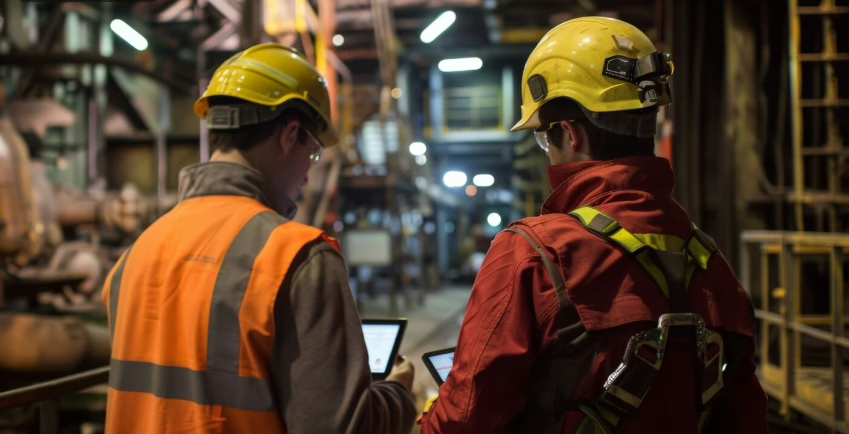
This equipment offers a vital protective layer between the workers and possible harm. Helmets, gloves, eye protection, and high-visibility clothing help protect against various hazards. There is special equipment designed for high-hazard occupations as well. In construction or maintenance activities where workers might be working at heights, a safety harness can mean the difference between a bad accident and a fatal one.
But equipment is only half the story: proper equipment selection, maintenance, and use are just as important as equipment itself. Physical safeguards include machine guards and safety barriers to reduce workers’ vulnerability to hazards.
Health and Safety Compliance Solutions
Even for seasoned leaders, managing multiple sets of rules and regulations across industries can be an uphill task. Health and safety compliance solutions can help organizations simplify documentation, audit trails, and reporting while ensuring that all rules and regulations are up to date.
Many organizations choose to invest in a reliable OHS management system that centralizes records, tracks training, and monitors performance indicators. While helping leaders comply with all legal and regulatory requirements, such systems can also aid in efficient decision-making and strategic planning for business objectives.

Risk Assessment and Hazard Identification
Systematic risk assessment is a way of anticipating problems before they get out of hand. This involves identifying risks and determining how to control them so as to eliminate risks entirely or reduce them to a manageable level. In various working environments, there are different considerations. In healthcare facilities, infection control and patient handling are considered, while in logistics centers, there is an assessment of the movement of vehicles and manual handling.
This ensures that there is a thorough understanding of risks and how to manage them without relying on paperwork only. In cases where there have been changes in the working process or layout, systematic risk assessment ensures that management is not based on outdated information.
Incident Reporting and Continuous Improvement
Excellent incident reporting can help organizations to convert failures and near misses into productive learning experiences. Employees should feel safe reporting problems without fear of reprisal.
Some basic reporting systems, rapid feedback, and visible corrective actions will create trust and confidence in the workplace. Information obtained from incident reports can be used to identify patterns, such as repeated slips or machine failures, that will help to drive improvement efforts. Only by closing the loop and analyzing and correcting the issues will organizations be able to grow continuously.
Bottom Line
The successful management of safety will require the combined application of the above methods as opposed to their separate use. Training builds knowledge and provides an understanding of equipment protection. Assessment helps to identify future hazards. Incident reporting creates motivation to identify potential ways to improve, and compliance solutions provide a framework to structure these methods into an overall safety management strategy.
By becoming familiar with how they apply to safety at different workplaces, organizations will develop a safer workplace so that people can perform their best work with the understanding that they are valued.
2 thoughts on “Key Safety Management Approaches Across Different Work Environments”